Home
Log In
RARE COINS AND TOKENS
Dedicated to serving Collectors Worldwide
COINS
TOKENS
MEDALS -MEDALLIONS
BANK NOTES
MODEL COINS/TOY MONEY
MISCELLANEOUS
ARCHIVE SALES
Categories
COINS->
(352)
TOKENS->
(2031)
MEDALS -MEDALLIONS->
(19)
BANK NOTES->
(2)
MODEL COINS/TOY MONEY->
(1)
MISCELLANEOUS->
(3)
ARCHIVE SALES
->
(5820)
|_ Southern Rhodesia
(1)
New Products ...
Featured Products ...
All Products ...
Search
Advanced Search
Useful Links
COIN HUNTER Web Site
GOOGLE Web Search
Information
Shipping & Returns
Privacy Notice
Conditions of Use
Contact Us
Site Map
More Information
Grading
Home
::
ARCHIVE SALES
:: James II, silver proof Gunmoney shilling May 1690
ARCHIVE SALES
Product 2950/5819
larger image
James II, silver proof Gunmoney shilling May 1690
Obverse: IACOBVS.II. DEI.GRATIA. , bust of James II left.
Reverse: 1690.MAG.BR.FRA.ET.HIB.REX. , crown over scepters dividing J R, value XII above, May. below.
Edge: Oblique milling.
Dublin mint.
S 6582 DDD , struck in silver. Extremely rare.
Timmins 1st edition TB12sM-1A (S); off-metal or restrike.
Timmins 2nd edition TB12sM-4A (S); off-metal or restrike.
A/ This particular die combination is interesting because both the obverse and the reverse dies have
been used in normal production and to make the off-metal strikes. The obv and rev dies are not
always kept together.
Punches were used in the construction of dies, there were complex punches for the image of James
II and the rev crown. The engraver would first add the portrait and the crown to the dies by use of a
hub press. He would then add the lettering (individual letter punches) and other bits and pieces of
the design to the dies by hand. There are known 41 different obv dies and 35 rev dies of the May
and May(.) Dublin small shillings. They were producing 1 or 2 die pairs per day to keep production
running.
This is a Dublin Mint die pair. The reverse die was used to strike base metal coinage in May and the
obverse die was used for base metal striking in June 1690 with a new June rev die in the Dublin Mint.
The dies were kept by the chief engraver who decided when and if they should be used. I believe
Monsieur Hupiere (from the French Mint) was in charge in Dublin at this time. When the Dublin Mint
was captured in early July 1690 by William of Orange. Hupiere left (with the dies) and travelled via
Limerick to Galway and left for France on the 13th Sep 1690. James II had set up court at Saint
Germain in Paris both during and after the Irish campaign. Hupiere became Chief engraver to James
II in France.
Your coin could have been struck in May or June 1690 at the Dublin Mint or during the period 1690
to 1701 at St Germain. It was common practice to give coins and medals as mementos to the
adherents of James II as a keepsake or to promulgate James’s image while in exile.
So your coin could be real or an early restrike !!!
Phil Timmins
Sold June 23
0 Units in Stock
Customers who bought this product also purchased...
Bentham, William Overend heart-shaped 1668 halfpenny
New Products [more]
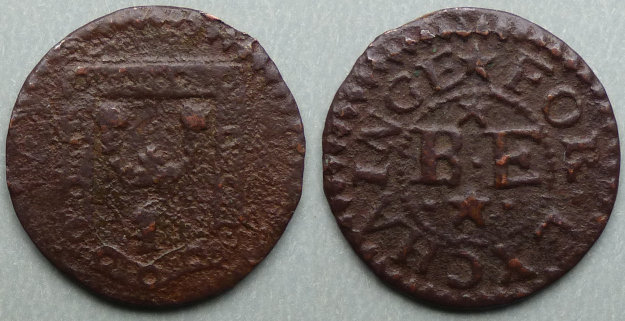
Evesham, borough issue farthing, N5669
£15.00
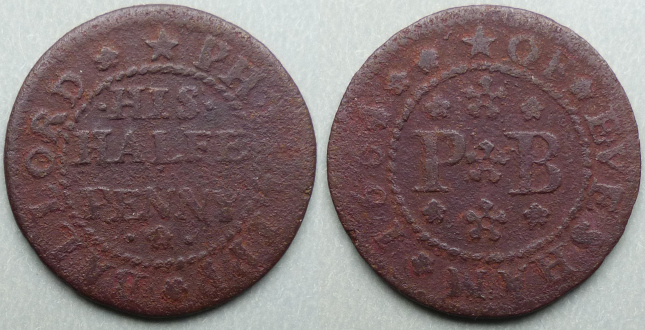
Evesham, Phillipp Ballord 1664 halfpenny
£26.00
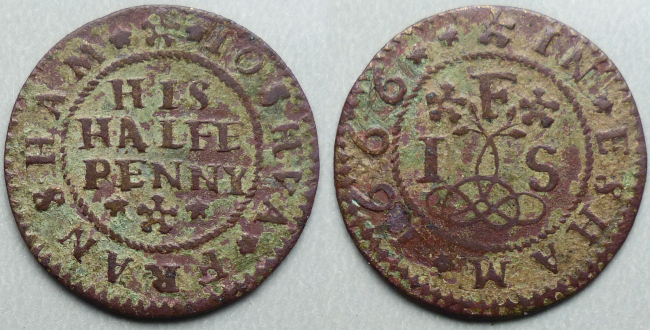
Evesham, Joshua Fransham 1666 halfpenny
£35.00
Featured [more]
Birmingham pub checks/tokens. "Once in a lifetime opportunity"
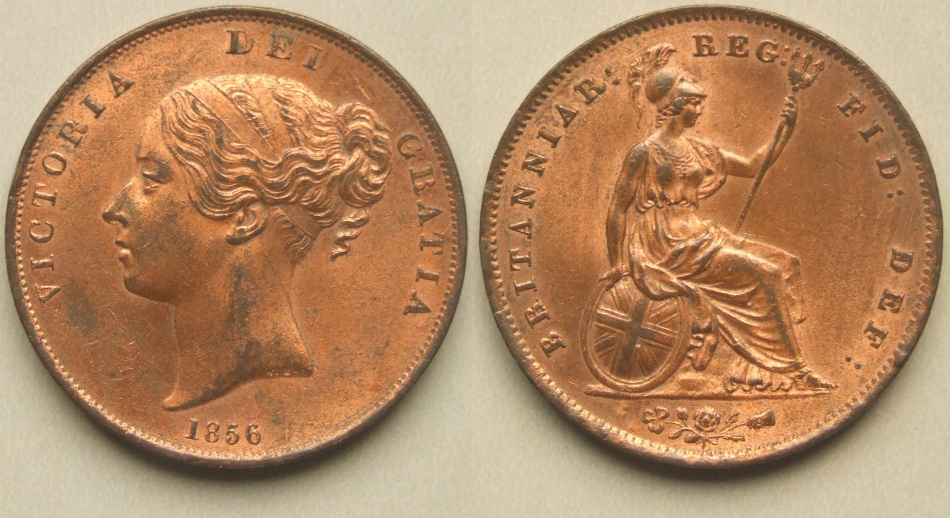
1856 OT penny